

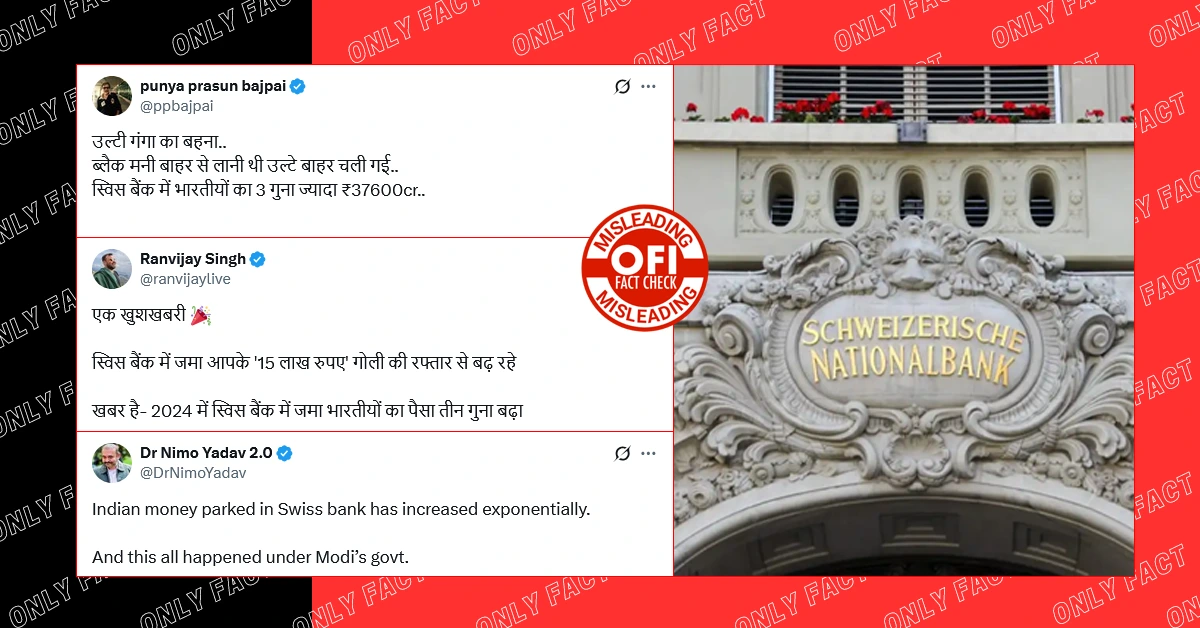
Recently, an Indian headline gained traction claiming that Indians’ money in Swiss banks has tripled in 2024. This news, often shared with an opinionated tone, went viral on social media with claims suggesting that the rise in Swiss bank deposits indicates a surge in corruption under the Modi government. Many social media users alleged that large-scale corruption is taking place under the current regime, prompting individuals to stash their ill-gotten wealth in Swiss banks.
Punya Prasun Bajpai stated, ‘The Ganga flowing in the reverse direction.. Black money was to be brought from abroad but it went abroad instead. Indians have 3 times more money in Swiss banks ₹ 37600cr..’
उल्टी गंगा का बहना..
— punya prasun bajpai (@ppbajpai) June 20, 2025
ब्लैक मनी बाहर से लानी थी उल्टे बाहर चली गई..
स्विस बैंक में भारतीयों का 3 गुना ज्यादा ₹37600cr..
Ranvijay Singh claimed, ‘A good news. Your ’15 lakh rupees’ deposited in Swiss bank is growing at the speed of a bullet. The news is- The money deposited by Indians in Swiss banks will increase three times in 2024. Narendra Modi had said that he will bring back black money and give 15 lakhs to everyone. Now 11 years have passed, you will get interest on 15 lakhs.’
एक खुशखबरी 🎉
— Ranvijay Singh (@ranvijaylive) June 20, 2025
स्विस बैंक में जमा आपके '15 लाख रुपए' गोली की रफ्तार से बढ़ रहे
खबर है- 2024 में स्विस बैंक में जमा भारतीयों का पैसा तीन गुना बढ़ा
नरेंद्र मोदी ने कहा था- वो काला धन लाएंगे और सबको 15 लाख देंगे
अब तो 11 साल बीत गए, 15 लाख पर ब्याज भी मिलेगा
पैसा ही पैसा होगा 😉 pic.twitter.com/sMeJUAHe8f
Priyamwada, Vijay Thottahil, Dr. Nimo Yadav, Mohit Chauhan, Cataleya and Roshan Rai shared a similar claim.
Also Read: Viral Video Claiming Israelis Are Pleading with Iran to Stop War is AI-Generated
Fact Check
We began our fact-checking process by reviewing credible news reports and relevant data on the topic. An NDTV report published on June 19, 2025, stated that Indian money parked in Swiss banks more than tripled in 2024, reaching 3.5 billion Swiss francs (approximately ₹37,600 crore). This surge was largely driven by a substantial increase in funds held through local branches and other financial institutions, according to annual data released by the Swiss National Bank (SNB).
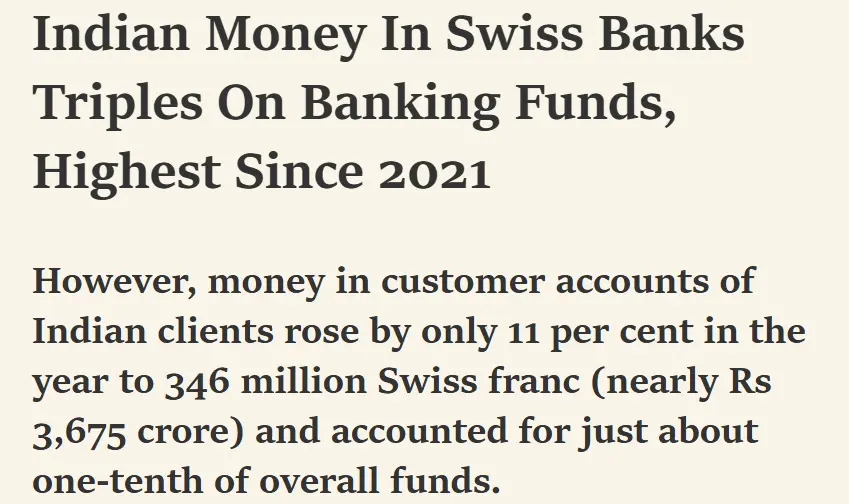
However, the report clarified that money held in customer accounts by Indian clients rose by only 11%, amounting to 346 million Swiss francs (around ₹3,675 crore), which represented just one-tenth of the total funds.
NDTV further noted that this sharp overall rise followed a 70% decline in 2023, when total funds parked by Indian individuals and companies—through various channels—fell to a four-year low of 1.04 billion Swiss francs.
A subsequent NDTV report on June 20, 2025, added that deposits by Indian clients in Swiss banks have declined by around 18% over the past decade, from approximately 425 million Swiss francs in 2015 to 346 million in 2024. Although there was a rise of 37 million Swiss francs from 2023 (when deposits stood at 309 million), the long-term trend remains downward.

A Business Standard report dated June 19, 2025, provided a detailed breakdown of the CHF (Swiss Francs) 3,545.54 million total Swiss bank liabilities towards Indian clients at the end of 2024, according to SNB data:
- CHF 346 million in customer deposits (up from CHF 310 million)
- CHF 3.02 billion held through other banks (up from CHF 427 million)
- CHF 41 million through fiduciaries or trusts (up from CHF 10 million)
- CHF 135 million in other financial instruments like bonds and securities (down from CHF 293 million)
These figures, based on reports submitted by banks to the SNB, do not account for so-called black money and exclude funds routed through third-country entities.
The report also highlighted that the highest-ever amount of Indian money in Swiss banks was nearly CHF 6.5 billion in 2006. Since then, the trend has generally been downward, with a few exceptions in 2011, 2013, 2017, 2020, 2021, 2022, and 2023.
According to the SNB, the data includes all categories of Indian client funds—ranging from individuals and corporations to banks—and covers deposits through Swiss bank branches in India and non-deposit liabilities as well.
In contrast, data from the Bank for International Settlements (BIS)—often considered a more accurate indicator of individual Indian deposits—reported a 6% rise in 2024, with total deposits reaching $74.8 million (about ₹650 crore).
Previously, BIS-tracked funds had fallen by 25% in 2023, 18% in 2022, and 8% in 2021. The last significant increase was in 2020, when deposits rose by 39%. Notably, in 2007, Indian deposits in Swiss banks had peaked at over $2.3 billion.

Important thing to note here is – While the SNB data covers all Indian-linked funds, the BIS figures focus specifically on individual deposits—often used to assess personal wealth movements
To sum it up, The Swiss National Bank (SNB) data highlighted that the highest-ever total amount of Indian money in Swiss banks was nearly CHF 6.5 billion in 2006. This figure includes all types of Indian-linked funds—from individual and corporate accounts to institutional investments, fiduciaries, and other financial instruments. While the overall trend since 2006 has been downward, there were some spikes in years like 2011, 2013, 2017, 2020, 2021, 2022, and 2023.
On the other hand, Bank for International Settlements (BIS) data, which focuses solely on deposits by Indian individuals, shows a decline over the past few years: a 25% drop in 2023, 18% in 2022, and 8% in 2021. The last major increase was in 2020, with a 39% rise. BIS data also indicates that Indian individual deposits in Swiss banks peaked in 2007 at over $2.3 billion. Unlike SNB, the BIS data is often considered a more accurate indicator of personal wealth movement and potential undisclosed savings abroad.
Why Has Indian Money in Swiss Banks Through Institutions Increased, According to SNB?
A report by The Economic Times, published on June 20, 2025, explains that the Swiss National Bank (SNB) data is based on official disclosures by banks and does not reveal details about alleged black money or accounts held through third-country entities. Swiss authorities have consistently emphasized that the funds reported in such data cannot be automatically classified as illicit.
The issue of so-called “black money” in Swiss banks has long been a hot-button topic in Indian politics, with successive governments and opposition parties frequently pledging to “bring it back.” However, Swiss banks are not merely repositories of hidden wealth. There’s a broader financial rationale that attracts institutions and wealthy individuals alike.
For the global elite, Swiss banks offer security and stability, particularly during times of geopolitical unrest or economic volatility. The Swiss Franc (CHF) remains one of the world’s strongest and most stable currencies, protected from the erratic fluctuations often seen in emerging market economies.
A website called Blake Harris further explains that the Swiss Franc’s appeal lies in its exceptionally low inflation, strong macroeconomic fundamentals, and 40% backing by gold reserves. These features make Switzerland an attractive destination for those looking to preserve and grow wealth in a politically neutral and economically stable environment.

The Geopolitical Context Driving the Shift
The recent surge in funds flowing into Swiss banks through banks and financial institutions—such as those reflected in the SNB data can be linked to worsening global geopolitical and economic conditions. The Russia-Ukraine war, ongoing since 2022, and the Middle East conflict involving Israel, Hamas, Hezbollah, and Iran, which escalated significantly in October 2023, have both disrupted global trade, energy prices, and investor confidence.
Compounding the instability, former U.S. President Donald Trump, during his 2024 presidential campaign and beyond, escalated trade tensions with multiple countries, reigniting fears of a global trade war. In response, China threatened to offload U.S. Treasury holdings, sparking turbulence in the global bond and currency markets. The U.S. dollar’s dominance has come under increased scrutiny, and emerging economies are now seeking safer alternatives for capital preservation.
In such an environment, financial institutions worldwide, including those in India, are turning to Swiss assets such as the Swiss Franc and gold-backed instruments to shield their capital from global uncertainty. Swiss banks, with their strict confidentiality, strong legal frameworks, and neutral political stance, are seen as a safe haven for institutional funds, not just individual savings.
Thus, the rise in Indian money in Swiss banks through financial institutions, as reported by SNB, is less about illicit wealth and more about financial strategy in a volatile geopolitical landscape. Amid global conflicts, economic uncertainty, and currency fluctuations, Swiss banks remain a trusted vault for safeguarding wealth for both individuals and institutions alike.
Also Read: SpaceX Starship Launch 2023 Video Falsely Shared as Iran’s Al-Fateh Missile Launch