

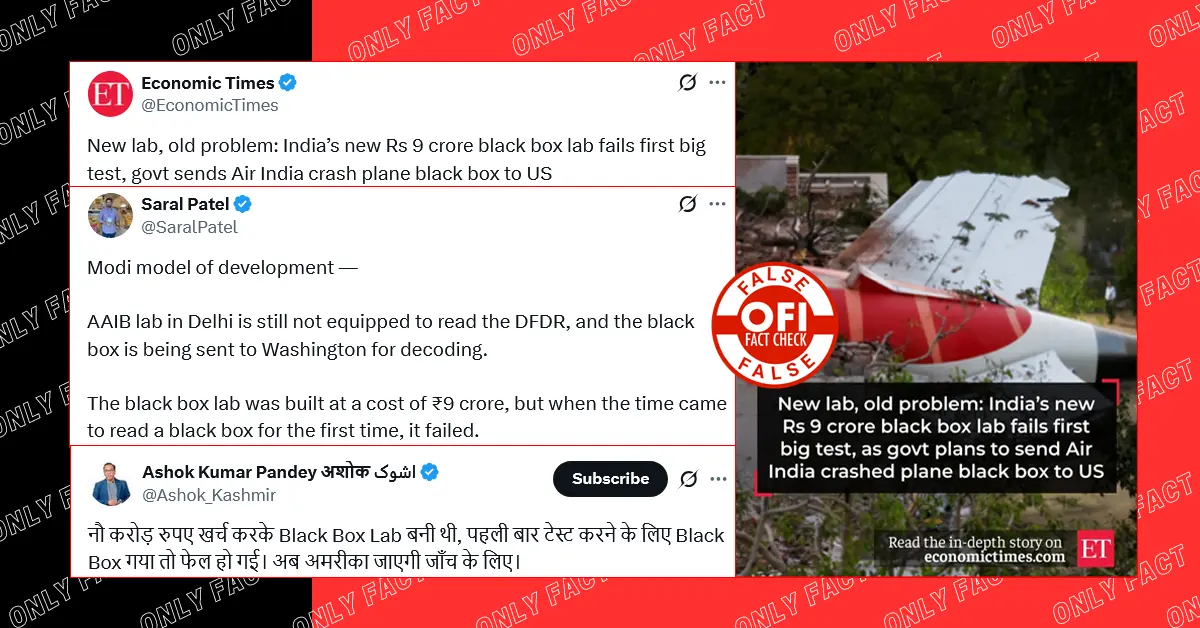
Air India flight AI171 crashed in Ahmedabad on June 12, 2025, killing 241 people on board and many others on the ground. After the accident, the AAIB launched a joint investigation along with experts from the US NTSB, FAA, UK AAIB, Boeing and GE Aerospace. During the investigation, two black boxes were recovered from the Boeing 786-8. One set was found on June 13 and the other on June 16. These boxes include the CVR and DFDR, which are used to ascertain the cause of the accident. After this, it is being claimed on social media that the black boxes made at a cost of Rs 9 crore failed the first lab test in Delhi and now the government is planning to send the black boxes to the US for further investigation.
The Economic Times reported, “New lab, old problem: India’s new Rs 9 crore black box lab fails first big test, govt sends Air India crash plane black box to US.” (archived link)
New lab, old problem: India’s new Rs 9 crore black box lab fails first big test, govt sends Air India crash plane black box to UShttps://t.co/h8QVXB1VIN#AirIndia #BlackBox #USA #India pic.twitter.com/LaldVrq3v0
— Economic Times (@EconomicTimes) June 19, 2025
Ashok Kumar Pandey claimed, “Black Box Lab was built by spending nine crore rupees, when the Black Box was sent for testing for the first time, it failed. Now it will go to America for testing. Amazing development is taking place.” (archived link)
नौ करोड़ रुपए खर्च करके Black Box Lab बनी थी, पहली बार टेस्ट करने के लिए Black Box गया तो फेल हो गई। अब अमरीका जाएगी जाँच के लिए।
— Ashok Kumar Pandey अशोक اشوک (@Ashok_Kashmir) June 19, 2025
ग़ज़ब का विकास हो रहा है! pic.twitter.com/kis2Y2h9Po
Another handle Saral Patel asserted, “Modi model of development — AAIB lab in Delhi is still not equipped to read the DFDR, and the black box is being sent to Washington for decoding. The black box lab was built at a cost of ₹9 crore, but when the time came to read a black box for the first time, it failed.” (archived link)
Modi model of development —
— Saral Patel (@SaralPatel) June 20, 2025
AAIB lab in Delhi is still not equipped to read the DFDR, and the black box is being sent to Washington for decoding.
The black box lab was built at a cost of ₹9 crore, but when the time came to read a black box for the first time, it failed. pic.twitter.com/giyLIpqhzF
The same claim was shared by many other handles like Munish Kumar Verma (archived link), Anand Prakash Vishwakarma (archived link), Rajan Rao (archived link), and Indian (archived link).
Also Read: SpaceX Starship Launch 2023 Video Falsely Shared as Iran’s Al-Fateh Missile Launch
Fact Check
In our research, we ran a keyword search related to the viral claim and found a Business Standard report. According to the report, on June 19, Aviation Minister Ram Mohan Naidu chaired a high-level meeting where he clarified that the black boxes are not being sent to the US for investigation and denied the media reports. He said that, based on technical and safety evaluation, the AAIB will decide the location for decoding the black boxes retrieved from the crashed Air India plane after assessment.
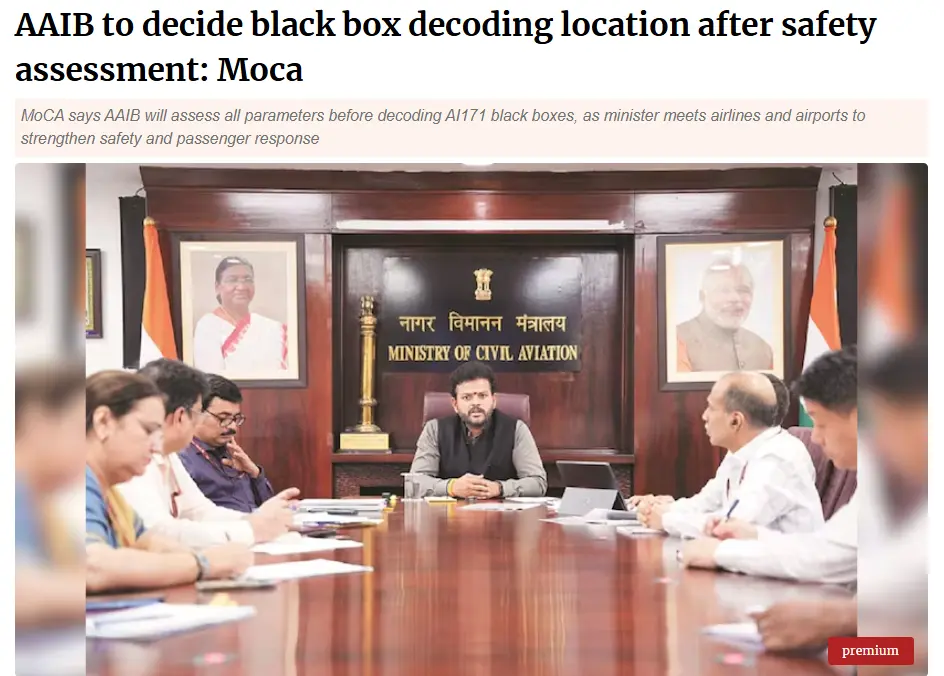
ANI quoted Ram Mohan Naidu in its X post, where he stated, “It has been reported in certain media outlets that the CVR/DFDR from the ill-fated AI171 flight is being sent abroad for retrieval and analysis. The decision regarding the location for decoding the flight recorders will be taken by the AAIB after due assessment of all technical, safety, and security considerations. The Ministry of Civil Aviation urge all stakeholders to refrain from speculation on such sensitive matters and to allow the investigative process to proceed with the seriousness and professionalism it warrants.” (archived link)
In conclusion, reports claiming that the black boxes retrieved from the Air India plane will be sent to America for investigation because they failed a lab test in India are false. The Aviation Minister has denied the media reports and clarified that the location for decoding the CVR and DFDR will be decided by the AAIB, and the media has been urged to refrain from publishing such unverified reports.
| Claim | India’s new Rs 9 crore black box lab fails first big test, govt sends Air India crash plane black box to US. |
| Claimed by | Economic Times, Ashok Kumar Pandey and others |
| Fact Check | The Aviation Minister has denied reports claiming that the black boxes will be sent abroad for investigation and stated that the AAIB will decide the location for their decoding. |
Also Read: Viral Video Claiming Israelis Are Pleading with Iran to Stop War is AI-Generated