
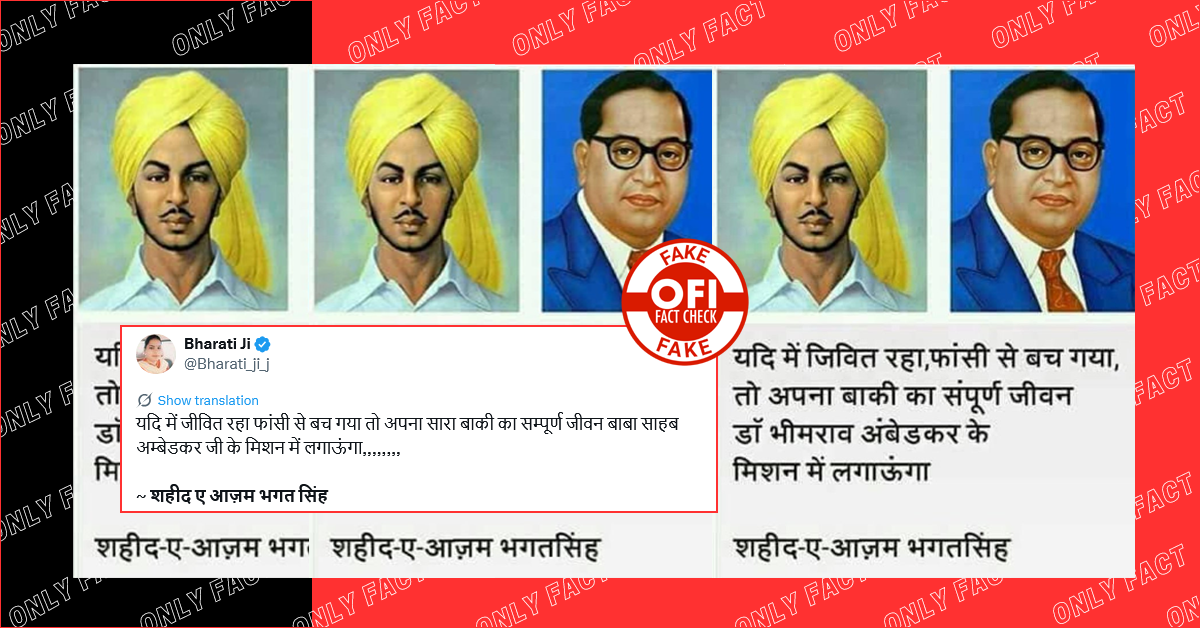
A post attributed to Bhagat Singh is being shared on social media claiming that he once said, “If I survive the hanging, I will devote my entire remaining life to Baba Saheb Ambedkar.” This post is shared alleging that Bhagat Singh pledged allegiance to Ambedkar’s social mission before his hanging in March 1931. (Archived link)
यदि में जीवित रहा फांसी से बच गया तो अपना सारा बाकी का सम्पूर्ण जीवन बाबा साहब अम्बेडकर जी के मिशन में लगाऊंगा,,,,,,,,
— Bharati Ji (@Bharati_ji_j) November 4, 2025
~ शहीद ए आज़म भगत सिंह pic.twitter.com/DCSmYxKKaj
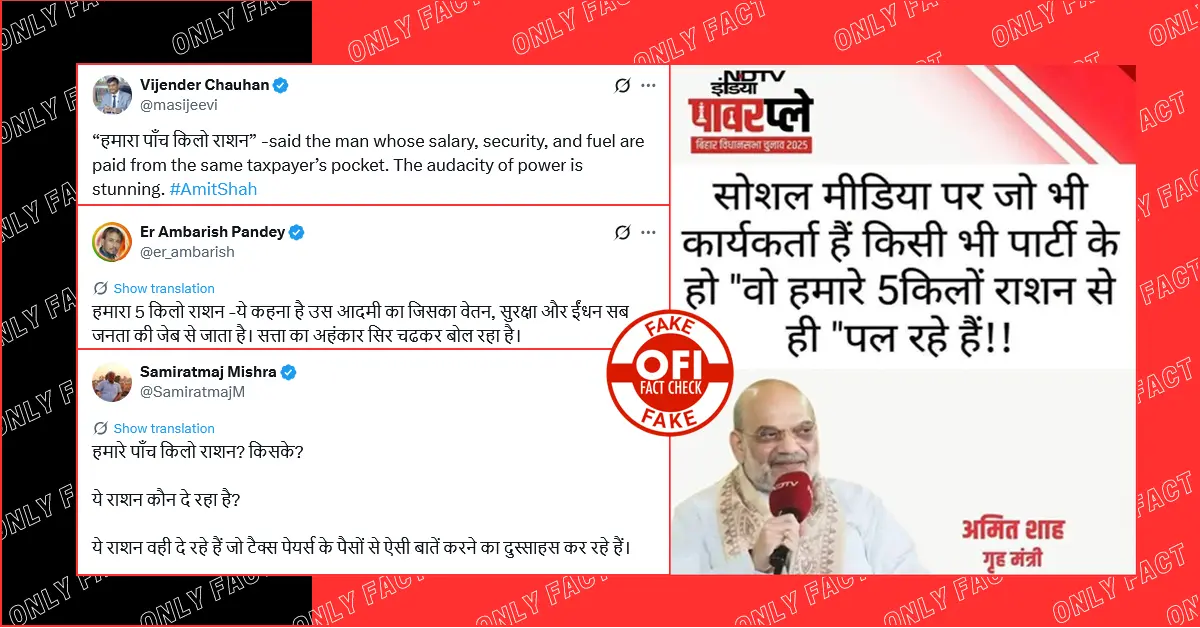
Also Read: Amit Shah Did Not Say Social Media Workers Survive On 5 kilos Ration; Viral Graphic is Edited
Fact Check
In our fact check research, we first conducted a simple keyword search on Google taking phrases from the claimed post like ‘Bhagat Singh Ambedkar pledge if I survive hanging’ and ‘Bhagat Singh devote life Ambedkar.’ During this, we only came across social media posts sharing this claim. Our search yielded no historical evidence or verified documents containing this quote.
In the next step, we examined the authenticated writings of Bhagat Singh, which are publicly available on the archives and scholarly collections, with digital transcriptions found on Marxist.org website.
To verify the authenticity of the claimed quote, we analyzed each of these writings of Bhagat Singh.
The Jail Notebook (1929-1931)
The Jail Notebook is a personal notebook of Bhagat Singh which is a collection of his writings. While imprisoned in Lahore Central Jail between 1929-1931, Bhagat Singh wrote on various subjects, including politics, economics, and social issues. This notebook is purely intellectual and ideological, containing excerpts from the books he was reading, his own thoughts and ideas. This book offers a glimpse into Bhagat Singh’s interest in Marxism, Leninism, and revolutionary ideologies and his vision for India’s future.
It discusses social justice, equality, atheism, and revolution but there is no mention of Dr. Ambedkar or any pledge to his social mission. The quote does not appear anywhere in it.
Essay- Why I Am an Atheist (October 1930)
“Why I Am an Atheist” is an essay written by Bhagat Singh explaining his reason for not believing in God or any supernatural power. This essay is a rational critique of religious beliefs, where he argues that the existence of God is not proven and the suffering and injustice in the world cannot be justified by the existence of a benevolent God. He also emphasized that the religion can be a tool for oppression and hegemony.
This essay explores Bhagat Singh’s belief, doubt, scientific thinking and rationalism, but it has no reference to Ambedkar or any vow dedicated to him.
Letter to Father (October 4, 1930)
In his letter to his father, Kishan Singh, dated October 4, 1930, written during his trial proceedings, Bhagat Singh expressed disagreement with his father’s legal petitions submitted to the Tribunal and protested against this move calling it a weakness. He reiterated that he is willing to sacrifice his life for India’s freedom struggle and does not want to defend himself before the court.
This letter deals with Bhagat Singh’s disagreement over his father’s legal petitions, and his conspicuous stance about his ideology. There is no mention of Ambedkar in this letter.
Letter to B. K. Dutt (1930)
This letter was written in November 1930, addressed to the revolutionary B. K. Dutt by Bhagat Singh following the decision of his death sentence. In this powerful letter, he wrote to his fellow comrade, about his eagerness to embrace death for his ideals. He encouraged B. K. Dutt, who had been sentenced to life imprisonment, to face it with courage and to show the world that revolutionaries can endure hardships and tortures.
The letter does not contain any mention of Ambedkar and his mission.
Letter to Young Political Workers (February 2, 1931)
This letter is a Bhagat Singh’s guidance to young political workers, where he discussed the importance of clear goal and strategy in the freedom struggle. He underlines the need for a socialist revolution, organizing labors and peasants, and forming a communist party. Bhagat Singh also emphasizes comprising values at certain stages during the struggle while maintaining a focus on the ultimate goal of complete revolution.
This letter focuses on political strategy, compromise, revolutionary organizations, Marxism, Leninism, the role of peasants and workers, critiques of Congress leaders like Gandhi and Nehru, and the need for communist party, but does not mention Ambedkar or his social mission.
Hunger-Strike Demands (1929-1930)
Bhagat Singh and B. K. Dutt while imprisoned in Lahore Central Jail, went on a hunger strike demanding better treatment for political prisoners. They requested that prisoners should be given better diet, be exempted from hard and undignified labor, have unrestricted access to books, writing materials and a standard daily paper, and be provided with better clothing and toilet necessities, as well as should be given separate wards with basic amenities.
This document is a detailed memorandum of demands for equal treatment and better conditions for Indian prisoners. The viral quote does not appear anywhere here.
Last Letter to Comrades (March 22, 1931)
We found Bhagat Singh’s last letter to his comrades in one of the articles from National Herald. This letter was written a day before his execution on March 22, 1931, from the Lahore Central Jail to his fellow revolutionaries and comrades. After Bhagat Singh was sentenced to death, members of the Hindustan Socialist Republican Association (HSRA), began hatching a plan to free Bhagat Singh. The words of these plans reached Bhagat Singh and he wrote this letter opposing the rescue plan.
In this letter, Bhagat Singh wrote that he was at peace with his fate and had no regrets dying for the country’s cause. He saw his death as a powerful political message which will inspire others towards freedom and social change and requested these revolutionaries to not risk their lives in rescuing him.
He also reflected upon his unfulfilled aspirations, and wrote, “And yes, one thought occurs to me even today that I have not been able to fulfil even one-thousandth parts of the aspirations that were in my heart to do something for my country and humanity. If I could stay alive and free, then I may have got the opportunity to accomplish those, and I would have fulfilled my desires.”
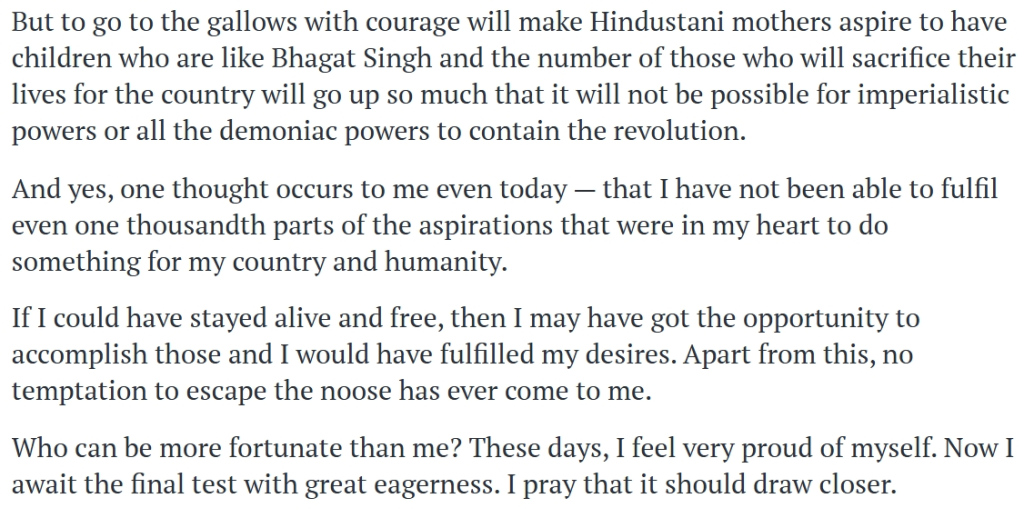
These excerpts from Bhagat Singh last letter shows that he had desired to live longer so that he could fulfilled his aspirations, but he accepted his fate. Even though, he talks about his desire of fulfilling his political mission here, there no mention of Ambedkar or a vow to assist him in his social mission.
Apart from these writings, we also analyzed his trial statements before the session court (June 1929), explaining his motives behind the Assembly bombing and the larger revolutionary struggle. This focuses entirely on his political motives and does not mention Ambedkar’s social motives.
After analyzing all primary writings, it is evident that the alleged quote attributed to Bhagat Singh does not appear in any of his writings. All verified sources from prison records including essays, letters, and trial statements do not support the claim. Bhagat Singh indeed expressed regret at not doing enough for nation and humanity, but he did not specifically mention about making allegiance to Ambedkar’s social mission. Hence, the claim that Bhagat Singh during his imprisonment pledged that he would dedicate his life to Ambedkar’s social mission is fake.
| Claim | Bhagat Singh pledged during imprisonment that he would dedicate his life to Dr. Ambedkar’s social mission. |
| Claimed by | Social Media user |
| Fact Check | Claim that Bhagat Singh pledged to dedicate his life to Ambedkar’s mission is false; no such quote exists in his verified writings or prison records. |
Also Read: Claim About Caste-Based Discrimination Against SC/ST Candidates in UPSC Interview Test is False