
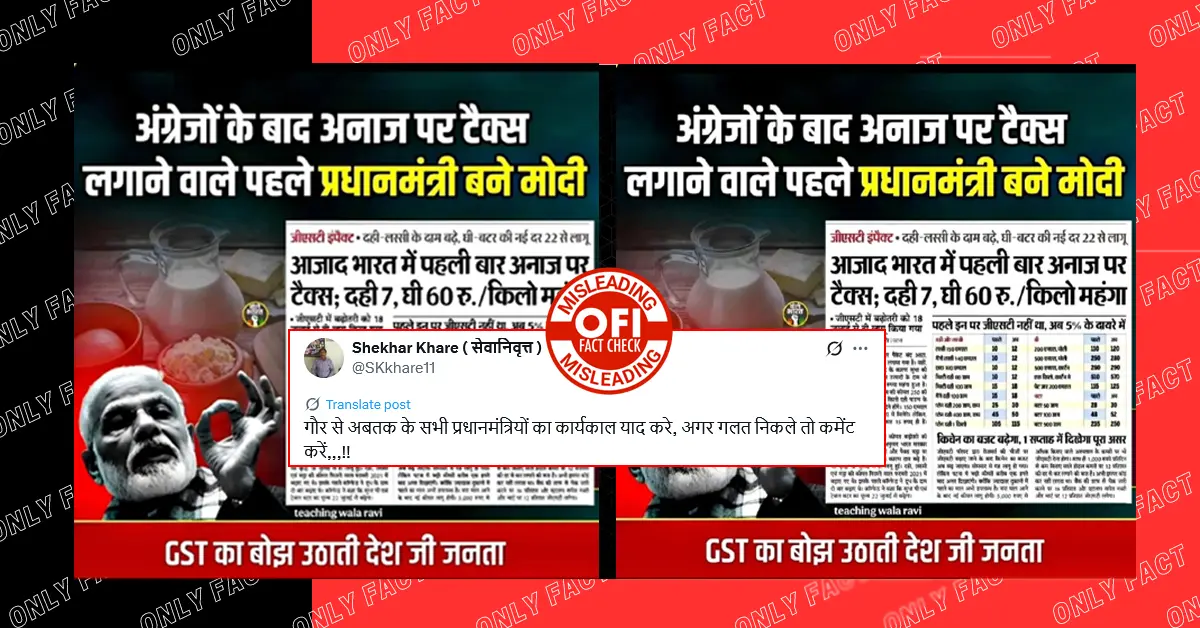
A graphic is going viral on social media in which it is being claimed that Narendra Modi has become the first Prime Minister to impose tax on food grains. A handle named Shekhar Khare shared this graphic and wrote, “Carefully remember the tenure of all the Prime Ministers till now, if it turns out to be wrong then comment.” (Archived link)
गौर से अबतक के सभी प्रधानमंत्रियों का कार्यकाल याद करे, अगर गलत निकले तो कमेंट करें,,,!! pic.twitter.com/QhMWKUgGO5
— Shekhar Khare ( सेवानिवृत्त ) (@SKkhare11) September 4, 2025
Another handle Rashmi Pal wrote, “There is no power in the government, the real power lies with the officers, judges, and media. When these are corrupt, the common man’s hopes are shattered. Blaming only the government now is dishonest! The system will be strong when there is transparency, accountability, and public awareness.” (Archived link)
सरकार में कोई ताकत नहीं,असली ताकत अफसरों,जजों और मीडिया में है।जब ये भ्रष्ट हों, आम आदमी की उम्मीदें टूट जाती हैं।सिर्फ सरकार को दोष देना अब बेईमानी है!सिस्टम मज़बूत होगा जब पारदर्शिता,जवाबदेही और जनता जागरूक हो #VoteChorGaddiChor#GodiMedia #VoterAdhikarYatra pic.twitter.com/jS65iIjs7J
— Rashmi Pal (@Rashmipal29) August 24, 2025
Also Read: Mohammad Rizvi Who Abused PM Modi Has No Links to BJP
Fact Check
In our research, we found a Times of India report dated July 19, 2022, which stated that facing criticism over the imposition of Goods and Services Tax (GST) on food items, Finance Minister Nirmala Sitharaman has clarified that before the implementation of GST, food items were taxed under Value Added Tax (VAT).
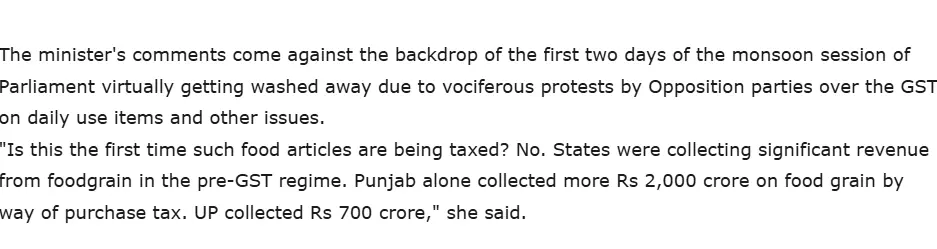
Before GST was implemented in 2017, food items were subject to Value Added Tax, introduced on April 1, 2005. State governments would levy VAT on food items such as rice, wheat, pulses, etc, which usually ranged from 4-5% depending on the state. Processed food items attracted both Excise Duty and VAT. By 2014, every state had implemented VAT.
We found that states like Punjab, Maharashtra, Chhattisgarh, Telangana, Kerala, Andhra Pradesh, Odisha, Himachal Pradesh, etc. have imposed VAT on rice.
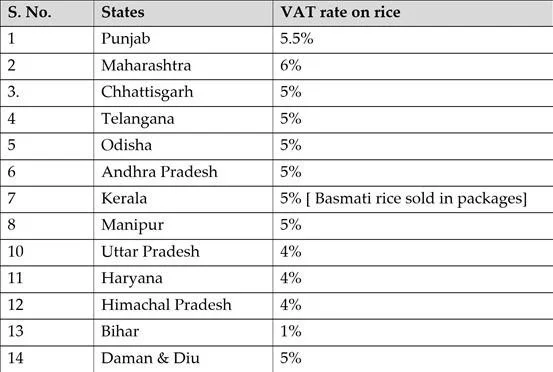
It is important to note that each state had its own VAT law. As a result, while some states like Kerala taxed packaged food grains, others exempted these food items from taxation.
However, the VAT system was replaced by Good & Services Tax in July 2017. This new taxation regime replaced the earlier systems systems such as VAT, Excise Duty and Service Tax at both the Centre and State levels. In 2022, the GST Council, during it’s 47th meeting, brought all pre-packaged and pre-labeled food items like rice, wheat, flour, pulses, curd, lassi, buttermilk under the ambit of 5% GST. Earlier, when GST was first implemented, these pre-packaged and pre-labeled food items were exempt. However, under this new decision, pre-packaged/labeled food items are taxed, loose/unbranded food grains/items remained exempt from GST.
In conclusion, the claim that Narendra Modi has become the first PM to implement tax on food grains is misleading. During pre-GST regime, food grains were taxed under VAT system.
| Claim | Narendra Modi has become the first Prime Minister to impose tax on food grains. |
| Claimed by | Shekhar Khare and Rashmi Pal |
| Fact Check | Before GST, food grains and items were taxed under VAT system. |
Also Read: 2017 Newspaper Clipping of BJP Leader Juhi Choudhary Arrested in Child Trafficking Shared as Recent