
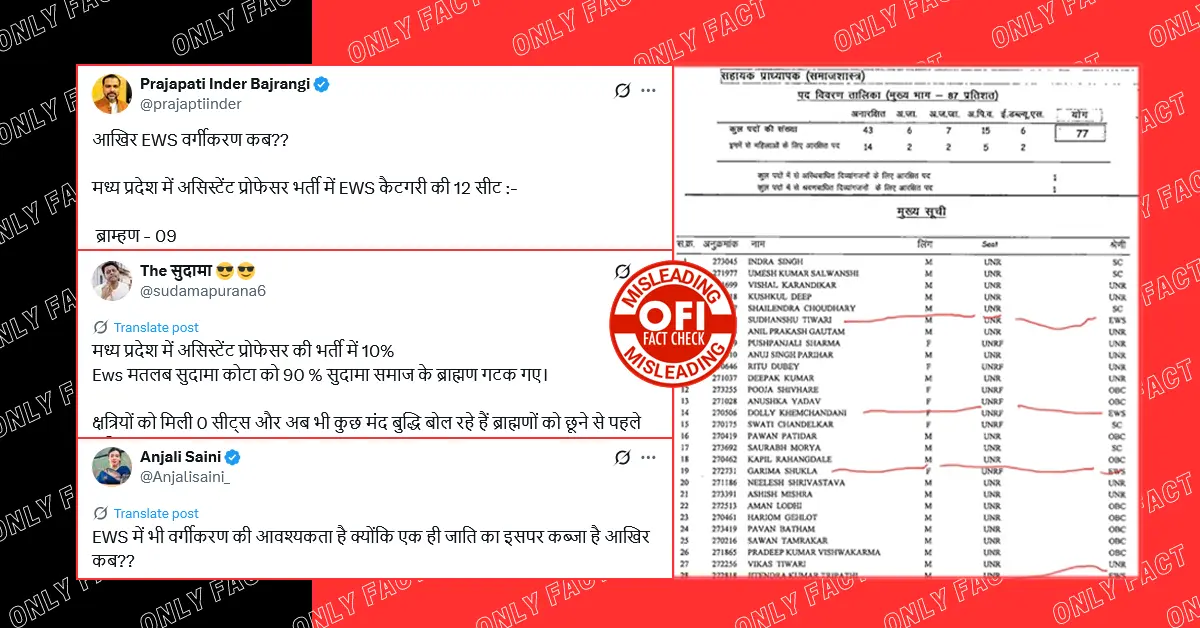
A screenshot of the result of Assistant Professor recruitment in Madhya Pradesh is going viral on social media. It is being claimed that there were 12 seats in the EWS (Economically Weaker Section) category, out of which 9 Brahmins, 1 Kayastha, 1 Jain, and 1 baniya candidate have been selected. It is also being alleged that no Kshatriya candidate was selected. The post further asserts that classification within the EWS category is necessary, as it is being dominated by a single caste.
Sharing the screenshot, the handle Sudama wrote, “In the Madhya Pradesh Assistant Professor recruitment, the 10% EWS quota meant for the Sudama category has been almost entirely taken over by Brahmins, who got 90% of the seats. Meanwhile Kshatriyas received zero seats.” (Archived link)
मध्य प्रदेश में असिस्टेंट प्रोफेसर की भर्ती में 10%
— The सुदामा 😎😎 (@sudamapurana6) October 13, 2025
Ews मतलब सुदामा कोटा को 90 % सुदामा समाज के ब्राह्मण गटक गए।
क्षत्रियों को मिली 0 सीट्स और अब भी कुछ मंद बुद्धि बोल रहे हैं ब्राह्मणों को छूने से पहले क्षत्रिय
की तलवार से टकराना पड़ेगा 🤣🤣🤣 pic.twitter.com/t69T43ccyn
Another handle Prajapati Inder Bajrangi asserted, “In the assistant professor recruitment of Madhya Pradesh, there were 12 seats in the EWS category – out of which 9 were Brahmins (Sudhanshu Tiwari, Garima Shukla, Jitendra Tripathi, Jyoti Tripathi, Ankit Dubey, Shalini Pandey, Ashish Upadhyay, Pragya Dubey, Satendra Upadhyay), 1 Kayastha (Rajeev Kumar Srivastava), 1 Jain (Yogendra Jain), and 1 Baniya (Dolly Khemchandani). No Kshatriya candidate was selected.” (Archived link)
आखिर EWS वर्गीकरण कब??
— Prajapati Inder Bajrangi (@prajaptiinder) October 13, 2025
मध्य प्रदेश में असिस्टेंट प्रोफेसर भर्ती में EWS कैटगरी की 12 सीट :-
ब्राम्हण – 09
1. सुधांशु तिवारी
2. गरिमा शुक्ला
3. जितेंद्र त्रिपाठी
4. ज्योति त्रिपाठी
5. अंकित दूबे
6. शालिनी पाण्डेय
7. आशिष उपाध्याय
8. प्रज्ञा दूबे
9. सतेंद्र उपाध्याय
कायस्थ… pic.twitter.com/xKJHTMZDBK
The same claim was also amplified by Anjali Saini. (Archived link)
EWS में भी वर्गीकरण की आवश्यकता है क्योंकि एक ही जाति का इसपर कब्जा है आखिर कब??
— Anjali Saini (@Anjalisaini_) October 13, 2025
मध्य प्रदेश में असिस्टेंट प्रोफेसर भर्ती में EWS कैटगरी की 12 सीट :-
ब्राम्हण – 09
1. सुधांशु तिवारी
2. गरिमा शुक्ला
3. जितेंद्र त्रिपाठी
4. ज्योति त्रिपाठी
5. अंकित दूबे
6. शालिनी पाण्डेय
7.… pic.twitter.com/MYMCGlu1pd
Also Read: Clip Showing Bull Damaging Lamborghini is Not Real, It’s AI-Generated
Fact Check
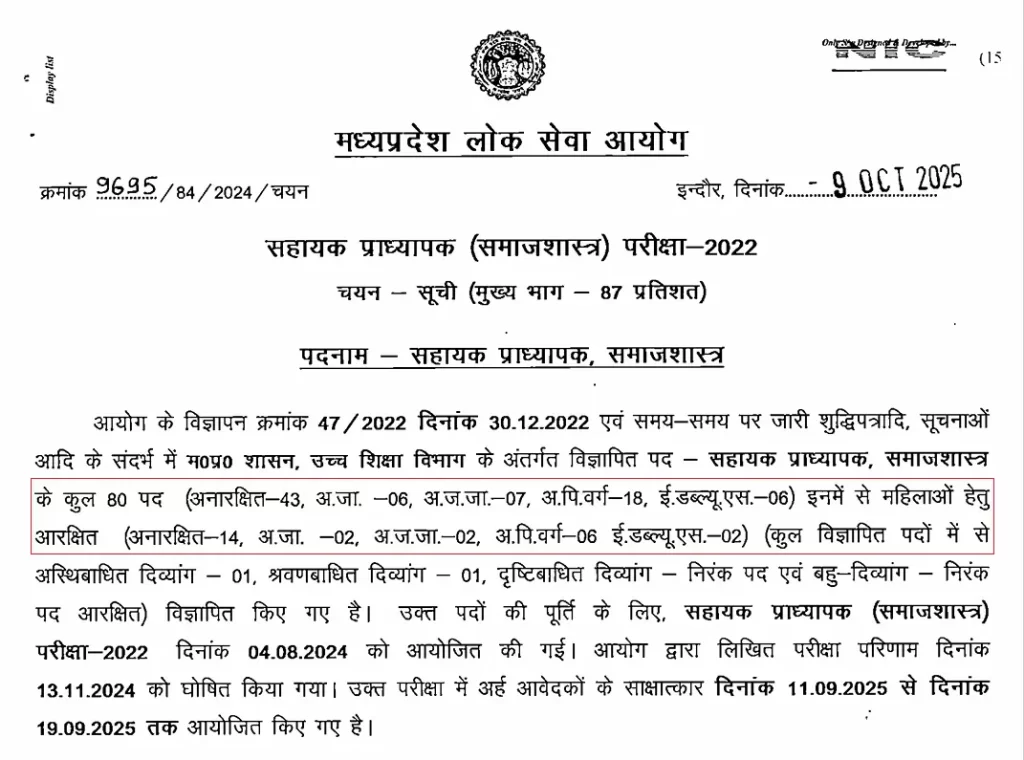
In our fact check research, we visited the official website site of Madhya Pradesh Public Service Commission, and found the notification posted on October 9, 2025. According to the official MPPSC document, the Assistant Professor (Sociology) exam was conducted on August 4, 2024, and the written exam results were announced on November 13, 2024.
Further, in the notification, we found the number of posts reserved for the Assistant Professor (Sociology) under the department of Higher Education. The category-wise distribution of these posts was as follows: Unreserved (UR)– 43, Scheduled Caste (SC)– 6, Scheduled Tribe (ST)– 7, Other Backward Classes (OBC)– 18, and Economically Weaker Section (EWS)– 6. Among these posts, certain posts were reserved for women (UR– 14, SC– 2, ST– 2, OBC– 6, EWS– 2).
Next, we found that under the EWS category there are 12 candidates: Sudhanshu Tiwari (UR), Dolly Khemchandani (UR), Garima Shukla (UR), Jitendra Kumar Tripathi (UR), Ankit Dubey (UR), Shalini Pandey (EWS), Yogendra Jain (EWS), Ashish Upadhyay (EWS), Pragya Dubey (UR), Rajiv Kumar Shrivastava (EWS), Vaishali Khandelwal (EWS), and Satendra Kumar Upadhayay (EWS).
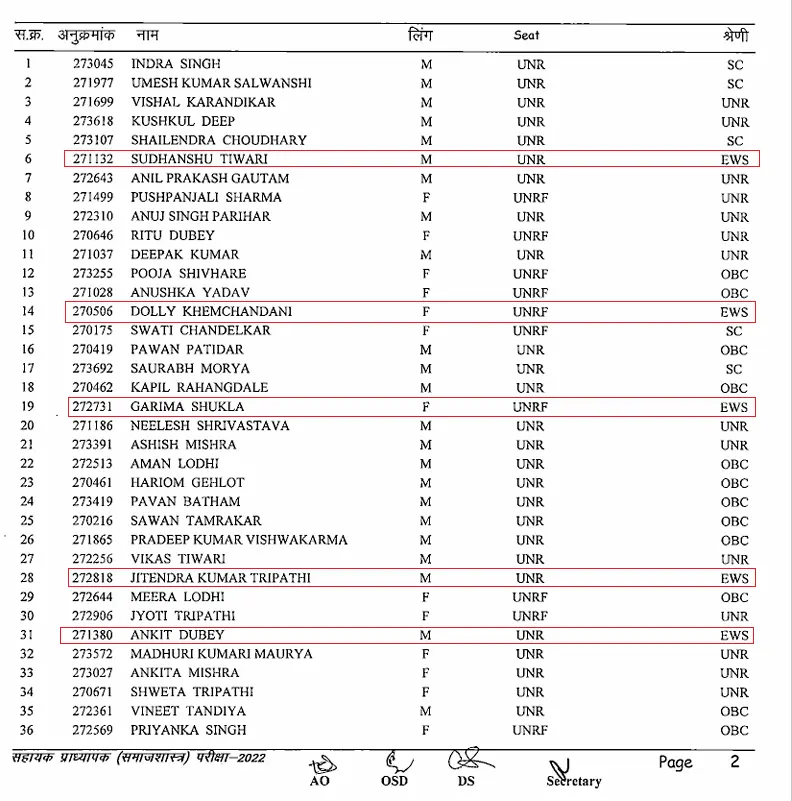
Out of these 12 candidates, Shalini Pandey, Yogendra Jain, Ashish Upadhyay, Rajiv Kumar Shrivastava, Vaishali Khandelwal, and Satendra Kumar Upadhayay, were recruited as EWS Assistant Prof under EWS seat, while other 6 candidates were recruited under Unserved category quota.
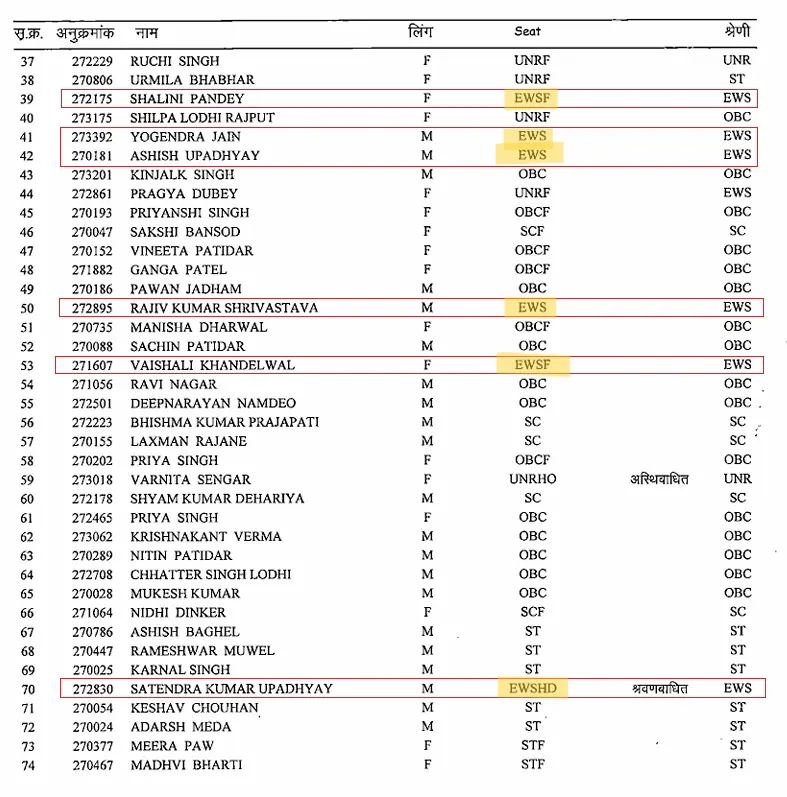
After this, we contacted Professor, Neelesh Tiwari of Exam Gurooji Coaching Institue, who had uploaded a video on his Exam Gurooji YouTube channel on October 9, 2025, regarding the Assistant Professor (Sociology) recruitment results in Madhya Pradesh. During our conversation, we asked him how 12 candidates appeared in the EWS category in the result list when only 6 seats are reserved for EWS candidates as mentioned in the notification.
He explained that all these 12 candidates appeared for the exam under the EWS category, but those with the higher scores were selected under the unreserved category. This means that only 6 candidates were actually selected for 6 EWS seats, while remaining candidates, although appearing under EWS, were recruited under the unreserved category due to their higher marks.
We also asked him why, out of 80 seats, only 74 candidates were recruited. He explained that since 2019, after the OBC reservation was raised from 14% to 27%, a legal battle has been ongoing in the court in which the decision was challenged, and a stay order was issued. Meanwhile, the exams were conducted, and the commission decided to adopt a middle-ground in this situation. The 87:13 formula is being used in Madhya Pradesh for OBC quota results, which allows recruitment to continue. This formula permits the results for 87% of advertised posts to be declared, while 13% of vacancies are held back because they are affected by the legal challenge.
Apart from this, the claim that no Kshatriya was recruited under the EWS category could also be because either no Kshatriya candidate appeared for the exam under the EWS category, or they did not qualify. If a Kshatriya candidate had appeared and qualified under the EWS category, they would have been selected.
In conclusion, the viral claim is misleading. While 12 candidates have been listed in the result under the EWS category section, only 6 candidates were actually selected under the EWS quota, and the remaining 6 had given exam under EWS category but were selected under the Unreserved (UR) category due to higher score. Therefore, the claim that 09 seats out of 12 EWS seats were taken by Brahmin is factually incorrect.
| Claim | There were 12 seats in the EWS (Economically Weaker Section) category, out of which 9 Brahmins, 1 Kayastha, 1 Jain, and 1 baniya candidate have been selected. |
| Claimed by | Sudama, Prajapati Inder Bajrangi, and Anjali Saini. |
| Fact Check | The claim is misleading. Only 6 candidates out of 12 were recruited for EWS Assistant Prof while others were recruited under Unserved category. |
Also Read: Old Video of Murder Convict Shot Dead in MP Misleadingly Attributed to UP