
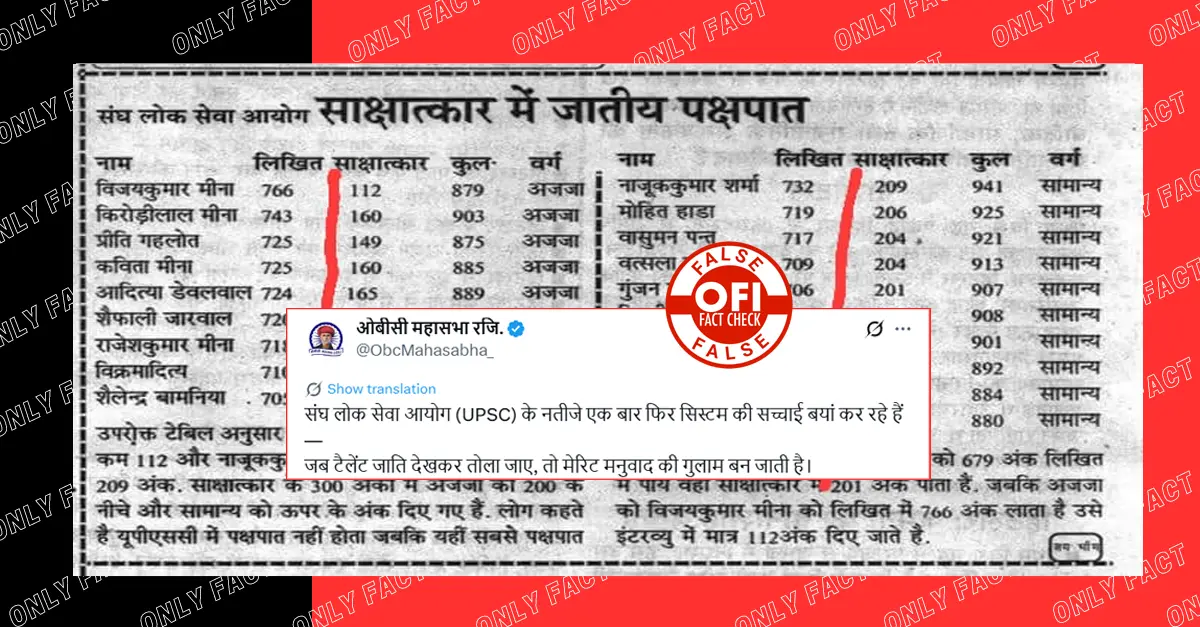
A screenshot of a Union Public Service Commission (UPSC) result is going viral on social media alleging caste bias in interviews conducted. In the screenshot, the table compares the8 marks of candidates from the Scheduled Castes (SC) and General (upper caste) categories. On the left side, candidates from the reserved categories have obtained higher marks in the written exam, but their interview scores are significantly lower. For example, Vishwakumar Meena scored 766 in the written exam but received only 112 in the interview, bringing his total to 879. On the right side, the scores of the general category candidates are shown. Their written marks are lower, but their interview scores are much higher than those of the reserved categories candidates. For instance, Nazuk Kumar Sharma scored 732 in the written exam, but received 209 marks in the interview, with a total of 941.
This screenshot is being shared claiming that selection is being done on the basis of caste, not merit. The UPSC interview process is biased based on caste, giving preference to candidates from general categories over candidates from reserved categories, who are deliberately given very low marks in the interview.
Sharing the screenshot, the handle OBC Mahasabha wrote, “The results of the Union Public Service Commission (UPSC) once again reveal the truth of the system — When talent is weighed by caste, merit becomes a slave to Manuvad. Students from the ST category score an average of 726 marks in the written exam, but only 142 marks in the interview! Meanwhile, those in the General category score 705 marks in the written exam, but 204 marks in the interview! This means that where hard work and merit should erase differences, the interview board, with its casteist mindset, widens the gap. Vijay Kumar Meena — Written 766, Interview 112 = 878. Nazuk Kumar Sharma — Written 732, Interview 209 = 941. If Meena had been given interview marks honestly — his total would have been 975, and he would have been ahead of Sharma. But no… here, it’s not merit, but lineage and caste that are considered. This injustice is not done based on religion, but on caste. This systematic dishonesty is repeated with SC, ST, OBC in every government recruitment.” (Archived link)
संघ लोक सेवा आयोग (UPSC) के नतीजे एक बार फिर सिस्टम की सच्चाई बयां कर रहे हैं —
— ओबीसी महासभा रजि. (@ObcMahasabha_) October 29, 2025
जब टैलेंट जाति देखकर तोला जाए, तो मेरिट मनुवाद की गुलाम बन जाती है।
ST वर्ग के छात्रों को लिखित परीक्षा में औसतन 726 अंक, लेकिन इंटरव्यू में केवल 142 अंक!
वहीं जनरल केटेगरी वालों को लिखित में 705… pic.twitter.com/5ERGjhuMqT
Another handle Rajkumar Bhati asserted, “The results of the Union Public Service Commission, i.e., UPSC, have recently been announced. A newspaper published a list of marks obtained in the written examination and interview by some candidates from the Scheduled Tribe (ST) and General category as a sample. Carefully examine both these lists. ST candidates scored an average of 726 marks in the written examination. They were given an average of 142 marks in the interview. On the other hand, General category candidates scored an average of 705 marks in the written examination and were given an average of 204 marks in the interview. To understand this clearly, analyze the marks of the first two candidates. Vijay Kumar Meena from the ST category scored 766 in the written examination and 112 in the interview. His total was 878. Nazuk Kumar Sharma from the General category scored 732 in the written examination and 209 in the interview. His total was 941.”
He further stated, “If the interviewers had not been unfair to Vijay Kumar Meena and had given him marks according to his talent, he would have received at least 220 marks in the interview. Even if he had been given 209 marks, equal to Nazuk Kumar Sharma, Vijay Kumar Meena’s total would have been 975, and he would have surpassed Nazuk Kumar Sharma in the merit list. Who exactly is responsible for this unfairness? I don’t know. But what I do know is that such unfairness is done to SC, ST, and OBC candidates in every government recruitment. And yes, this unfairness is not based on religion but on caste.” (Archived link)
संघ लोक सेवा आयोग अर्थात UPSC के परिणाम हाल ही में घोषित हुए हैं। एक अखबार ने नमूने के तौर पर अनुसूचित जनजाति (ST) और सामान्य वर्ग (General) के कुछ प्रतियोगियों को लिखित परीक्षा और इंटरव्यू में मिले अंकों की सूची छापी है।
— Rajkumar Bhati (@rajkumarbhatisp) May 4, 2025
इन दोनों सूचियों को गौर से देखिए। एसटी के… pic.twitter.com/jOA2Y801yd
The claim was also shared by Vinod Kumar Meena (Archived link) and on Facebook by Bhupendra Yadav Socialist (Archived link).
Also Read: Viral Delhi Acid Attack Claim Turns Out to Be Fabricated Story
Fact Check
In our fact check research, we found that this UPSC exam result is from the year 2015. After reviewing this, it was found that the claim circulating online is misleading. In this list, we found the names of many general category’s candidates whose interview scores were lower than those of candidates from the reserved categories. Additionally, we verified the categories of these candidates through another website.
For example, if we look at the marks of the top 10 students on the first page of the list, Tina Dabi, ranked first, from the SC category scored 868 in the written examination and 195 in the Personality/Interview test. In comparison, Artika Shukla from the General Category scored lower than Tina Dabi in both the written and interview rounds, with 827 and 173 marks respectively. Another name is Shashank Tripathi, who obtained 824 in the written exam and 172 in the interview. Similarly, Kumbhejkar Yogesh Vijay from the General category scored 845 in the written exam and only 138 in the interview.
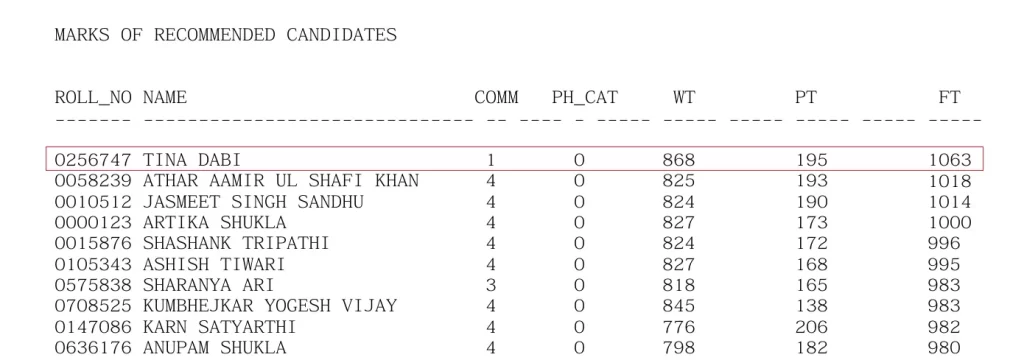
This shows that candidates from the General category are not necessarily given higher marks in the interview stages because of their category, rather, the evaluation is based on individual performance. Tina Dabi (SC category) scored higher than several General category candidates both in the written and interview rounds. Her selection and high ranking were based on merit.
After this, we shortlisted the names of reserved categories (SC/ST) candidates from the list who scored more than 180 marks in the interview test. In total, we found the names of 24 such candidates. The names are given below:
| Reserved Category Candidates | Written Examination Marks | Interview Test Marks |
| Nazuk Kumar (SC) | 732 | 209 |
| Akriti Sagar (SC) | 711 | 193 |
| Amit Aasery (SC) | 701 | 182 |
| Inderjit Singh (SC) | 681 | 198 |
| Vishal Sagar (SC) | 696 | 182 |
| Badhavath Chandrakanta Rathore (SC) | 680 | 187 |
| Sharat Chandra Pawar (SC) | 687 | 182 |
| Kunal Dudawat (ST) | 675 | 182 |
| Abhishek Verma (SC) | 668 | 195 |
| Amit Renu (SC) | 652 | 195 |
| Amit Kumar Anand (SC) | 657 | 190 |
| Sundaravathanam E (SC) | 660 | 185 |
| Neetika Vilas (SC) | 659 | 184 |
| Pushpalata (SC) | 642 | 198 |
| M Thangsuangang Zou (ST) | 641 | 192 |
| Geeth Badoliya (SC) | 650 | 182 |
| S Vysak (SC) | 638 | 193 |
| Navneet Kumar Kanwat (ST) | 683 | 187 |
| Shivam Dattatray Dhamanikar (SC) | 641 | 187 |
| Dondapati Venkata Harish (SC) | 628 | 182 |
| Duyu Kampu (ST) | 628 | 182 |
| Sushma Negi (ST) | 627 | 184 |
| Ajay Soyal (SC) | 632 | 182 |
| Minga Sherpa (ST) | 632 | 182 |
In the entire list, we found that Nazuk Kumar from the SC category, secured 209 marks in the interview test, the highest in the entire list. After her, there are several other reserved category candidates such as Inderjit Singh, Abhishek Verma, Amit Renu, and Pushpalata, who scored marks close to 200.
It is also important to note that in the viral screenshot, the first name under the General Category is of Nazuk Kumar Sharma, who, despite scoring fewer marks than the SC candidate Vijay Kumar Meena, somehow managed to secure 209 marks in the interview round. However, in the complete list, there is only one Nazuk Kumar belonging to the SC category who received 209 marks in the interview stage, and there is no candidate named Nazuk Kumar Sharma. This indicates that the name Nazuk Kumar Sharma was falsely added to the General category list to suggest that the candidate who scored highest marks in the interview test belongs to the General category.
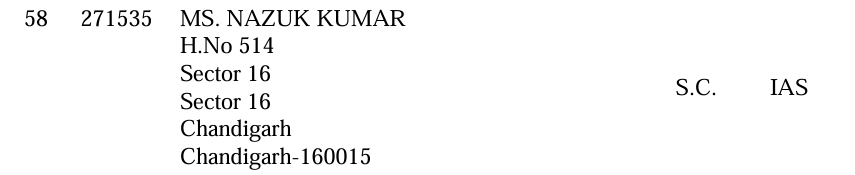
We also checked the social media profiles of IAS officer Nazuk Kumar. Nowhere has she added ‘Sharma’ to her name. On every platform, she goes simply by the name Nazuk Kumar.
In the next step, we shortlisted the names of General category candidates who scored less than 170 marks in the interview round. The names of the candidates among them are provided below in the table:
| General Category Candidates | Written Examination Marks | Interview Test Marks |
| Ajit Roy Togare | 694 | 132 |
| Vijay Singh | 705 | 138 |
| Manoj Kumar Pandey | 687 | 157 |
| Goldi Sharma | 693 | 154 |
| Utkarsh Mishra | 725 | 154 |
| Sumit Kumar Agrawal | 733 | 154 |
| Abhinav Agnihotri | 760 | 138 |
| Rimjhim Pandey | 751 | 150 |
| Amitabh Mishra | 745 | 157 |
| Anant Dwivedi | 757 | 151 |
| Kantesh Kumar Mishra | 763 | 157 |
| Vinit Agrawal | 765 | 157 |
| Ashok Mishra | 772 | 151 |
| Atul Sharma | 780 | 146 |
| Indrajit Panda | 563 | 149 |
| Atul Krishna Ray | 584 | 138 |
| Seema Choudhary | 582 | 154 |
As claimed, it was asserted that although the SC candidate scored higher in the written exam, they were given only 142 marks in the interview, however, this is not true. Among the General candidates listed above, some candidates such as Ajit Roy Togare, Vijay Singh, Atul Sharma, and Atul Krishna Ray, received interview marks that were either lower than or nearly equal to a score of 142.
In this result list, the candidate who scored the lowest marks in the Interview exam was from the reserved category, Vijay Kumar Meena, who secured 112 marks. However, the candidate who scored the highest marks in the interview were also from the same category, Nazuk Kumar who received 209 marks, and Tina Dabi, who scored 204 and secured the first rank.
In conclusion, the claim that reserved category candidate received unfairly low marks in the interview test due to their caste is false. Along with the reserved category candidates, many general category candidates also secured low marks in the interview test, while several reserved category candidates performed better than many general category students. Even though, Vijay Kumar Meena, the SC candidate, scored the lowest marks in the interview, the highest-scoring candidate also belonged to the same category. This makes it evident that the interview marks were not biased against reserved category candidates. Moreover, the SC candidate, Nazuk Kumar, who scored the highest in the interview round, is being falsely claimed to be from General category to amplify the narrative of caste discrimination in the civil service examinations.